
Sustainability as a Leadership Superpower.
Using Constraint to Compete and Win in Uncertain Times.
A 2025 year-end thoughtpiece by Devry Boughner Vorwerk for Boards, CEOs, and executive teams.
Why this moment feels different.
As we close out 2025, most executives feel and are constrained and are looking for ways to lead more effectively.
I don’t believe it’s because leadership capacity has diminished, but because the business environment has drastically changed shape this year.
Regulatory pressure is uneven and accelerating.
Supply chains remain exposed.
Capital is more selective and conditional.
Political and geopolitical forces are bleeding into markets.
Customers and employees expect coherence, not slogans.
Individually, none of this is new. What is new is the simultaneity—and the speed with which decisions harden into structure.
As a result, many leaders are making careful, responsible decisions while carrying a quiet concern:
Are these choices actually strengthening the business—or just helping us cope?
That question is the right one.
Sustainability isn’t the problem. It’s the signal.
Sustainability is often experienced as one more thing being forced onto leaders—
yet another obligation layered onto already complex decisions.
That framing is understandable, and it’s also incomplete.
Sustainability keeps surfacing across industries because it is where multiple constraints converge first:
regulation;
supply chain resilience;
capital access;
workforce stability;
customer trust; and
long-term cost structure.
Sustainability is not creating these constraints. In fact, sustainability is revealing them early.
I believe that’s why “sustainability” or Environmental Social and Governance (ESG) reporting feels uncomfortable. And why sustainability is strategically useful.
Constraint is where leadership actually shows up and grows up.
Most leaders instinctively treat constraint as the enemy of growth.
In practice, constraint is where future performance is already being shaped.
When leaders engage sustainability as a leadership lens—not a belief system or compliance exercise—it clarifies where decisions are quietly locking in:
cost
capability
access to markets
and competitive position
Strong, capable, future-focused leadership does not resist constraint; it uses it deliberately.
The leadership sequence that matters now:
The following is the sequence that separates organizations that endure from those that react and differentiates leaders as the “grown ups” in the room:
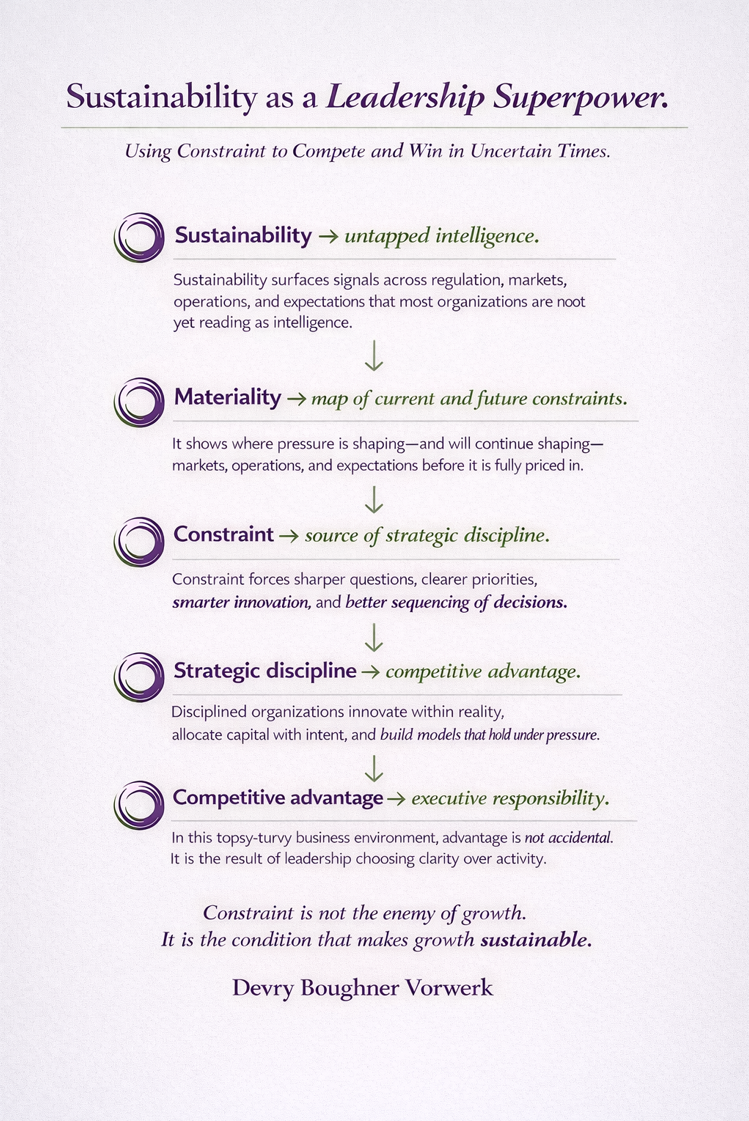
Sustainability → untapped intelligence. Sustainability surfaces signals across regulation, markets, operations, and expectations that most organizations are not yet reading as intelligence.
Materiality → map of current and future constraints. It shows where pressure is shaping—and will continue shaping—markets, operations, and expectations before it is fully priced in.
Constraint → source of strategic discipline. Constraint forces sharper questions, clearer priorities, and better sequencing of decisions.
Strategic discipline → competitive advantage. Disciplined organizations innovate within reality, allocate capital with intent, and build models that hold under pressure.
Competitive advantage → executive responsibility. In this topsy-turvy business environment, advantage is not accidental. It is the result of leadership choosing clarity over activity.
Sustainability is not about doing more, it is about competing differently.
Sustainability matters, especially for small and mid-sized enterprises.
Large, more diversified organizations can absorb leadership misalignment for longer. SMEs cannot.
For SMEs businesses:
capital allocation errors compound quickly;
operational rigidity becomes costly fast; and
reputational shifts move ahead of response cycles.
It’s where I see leaders get the most paralyzed on sustainability: viewing it through the lens of all burden, no reward. At the same time, SMEs have a critical advantage: the ability to realign quickly when clarity exists.
Leaders who use sustainability as a constraint-mapping tool—not a reporting function—move sooner, with more confidence, and with less rework.
The immediate opportunity is in front of leaders.
The most effective executives right now are not chasing certainty; they are building strategic orientation.
They are:
identifying which constraints actually shape competitiveness;
using sustainability as early intelligence, not ideology;
aligning innovation, risk, and growth decisions; and
making fewer moves that do more work
Sustainability does not eliminate volatility. Sustainability turns uncertainty into strategic terrain.
Seen clearly, sustainability is not a burden.
It is a leadership superpower.
A closing note.
If sustainability feels unavoidable but misaligned—
if risk management feels busy but unsatisfying—
if innovation feels constrained rather than sharpened—
There may be an opportunity to reframe your company’s landscape.
My team and I work with leadership teams to clarify what is truly material, surface hidden constraints, and align strategy so it performs under pressure.
If this leadership question is active for you, I’m open to a short conversation in 2026 to map the environment you’re navigating—and even if your strategic plan is already written, let’s review it together and assess where advantage can still be built within it.